
Dispiriting mortgages, and disproportionate columns
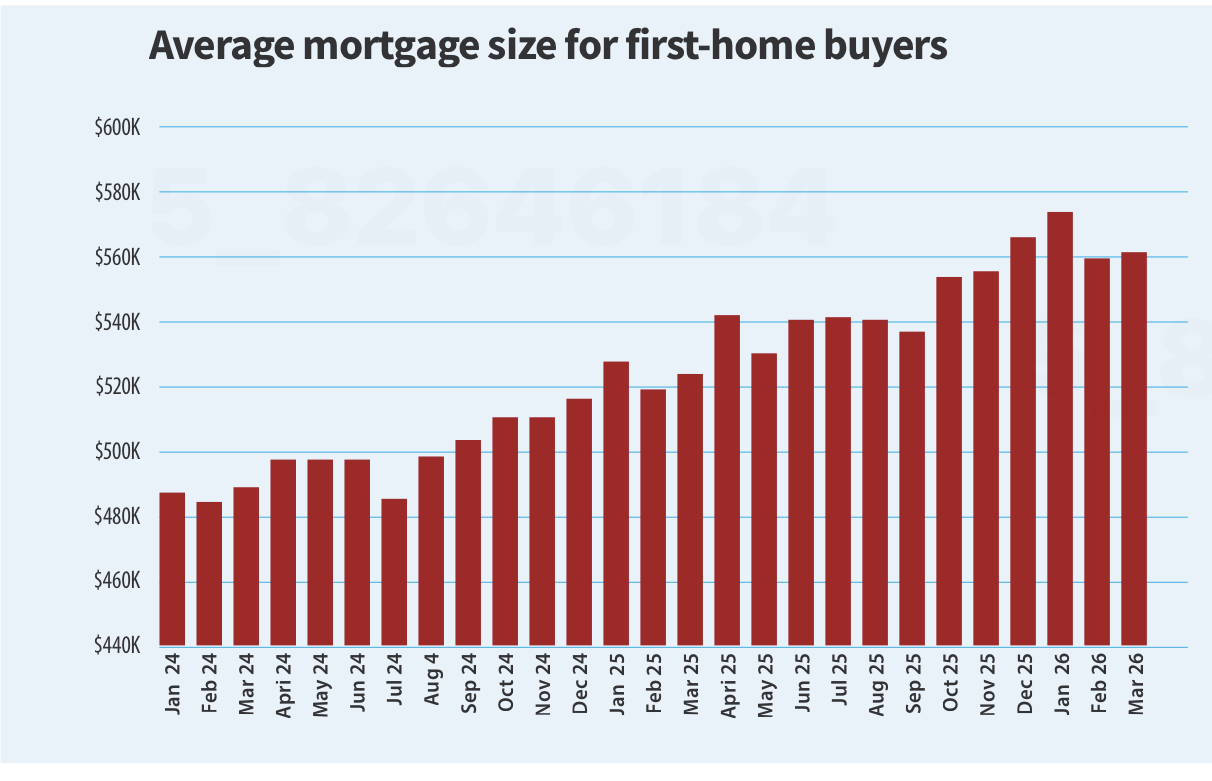
A chart in a recent article in the Listener likely caught the attention of people hoping to buy their first homes, and possibly their parents too. The column chart shows the average mortgage size for first-home buyers, using data from credit bureau Centrix. It is included in an article considering whether first-home buyers are ending up with larger mortgages because the Bank of Mum and Dad is drying up.
Bigger Mortgages by Eric Fryberg, New Zealand Listener, 3 October 2026, page 20. Reproduced for purposes of education, criticism and commentary.
The chart certainly makes the mortgages look bigger. The last column in the chart (March 2026) is about two and a half times as tall as the first column (January 2024). The values shown in the chart confirm that first-home buyers are borrowing more; however, the difference in the value of the average first-home buyer mortgage between January 2024 and March 2026 represents an increase of only about 15%.
This example offers three lessons that apply beyond housing: how the size of a change is shown, what it is compared with, and the source of the data.
Numerical axes should start at zero
The value of data visualisations stems from the ability of our brains to perceive patterns from pictures, so when the height of one column appears to be about two and a half times the height of another our brains quickly make the inference that whatever is being measured has more than doubled in size. In this case the axis begins at $440,000 and goes to $600,000, which makes the $74,000 difference between the value for January 2024 (about $487,000) and March 2026 (about $561,000) appear much larger than it really is even though the axis is clearly labelled, and the article text reports the values accurately.
Sometimes this happens by accident. Unfortunately, a lot of software defaults to showing only the range of an axis where there is a change. Other times those creating a data visualisation believe that showing just the portion of the axis where there has been a change will make it easier to see since starting the axis at zero would make the columns look much more similar. But the goal of a visualisation should be to leave the viewer with an accurate understanding of the situation the data represents. As in this situation, that often means a modest change in one direction or another rather than a dramatic one. Where seeing the detail is important, the actual values can be provided or the type of chart that incorporates a magnified pull-out can be used. Either of those options allows for the detail to be shown within its broader context, which will leave the viewer with a more accurate understanding.
Lesson: Don’t truncate numerical axes to show only the portion that changes during the period of interest. It distorts viewers’ perception of the magnitude of the change.
Add comparative data if it enhances understanding
Is a 15% increase in the average mortgage a lot? On its own, it is hard to say. If house prices had also risen 15% over the same period, bigger mortgages would be unremarkable — buyers’ share of equity in their homes would remain about the same.
In this case, the text of the article says: first-home buyers have been borrowing more at a time “when house prices have been flat or cheaper”. That contrast is the most interesting part of the story, yet it is not reflected in the chart.
Between January 2024 and March 2026, the national median sale price reported by REINZ rose from $760,000 to $788,000, an increase of about 4%. Interest.co.nz’s estimate of the average price paid by first-home buyers rose from about $657,000 to about $692,000, an increase of about 5%. A 15% rise in home loans against a 4–5% rise in house prices is a much more notable finding than a 15% rise in average mortgage values on its own.
A chart showing both series could have visually told the story of a closing gap between house prices and mortgages for first-home buyers. For example, data (from the same source, for reasons described in the following section) could have been shown by quarters, with columns in one colour showing average prices of houses purchased by first-home buyers and columns in another colour showing average mortgages for first-home buyers. Or alternatively it could have been a single data series showing the value of an average mortgage as a percentage of the value of an average house.
Lesson: Numbers become more meaningful when put into context by showing them in relationship to other important values or benchmarks.
Check whether the direction or magnitude of a conclusion depends on the source
There is a catch in the comparison above: the mortgage values and the house prices come from different sources.
Centrix is a credit bureau, and its mortgage figures come from the credit information lenders report to it. The Reserve Bank publishes its own monthly figures on new mortgage lending to first-home buyers, and the two don’t match. Using Reserve Bank data, first-home mortgages grew by about 7% (calculated from interest.co.nz figures for January 2024 and March 2026) over the time shown in the chart. Comparing that against the same 5% increase in average house prices for first-home buyers during that period implies slower closing of the gap between house prices and mortgages for first-home buyers.
The discrepancy between sources probably results from measurement differences in things such as how first-home buyers are identified, which loans are counted, and when. A sentence noting that Reserve Bank lending data show a smaller increase in the average size of first-home mortgages would have provided further evidence that there is indeed a closing gap while also signalling uncertainty about the magnitude of the gap.
Lesson: When reputable sources disagree, and the conclusion depends on which one you use, let the reader know.
The general gist of this part of the article — that the size of mortgages for first-home buyers is increasing — is interesting and true, if somewhat depressing for those first-home buyers, and potentially their parents. Artificially inflating their perception of the magnitude of that increase does not help tell that story more clearly. Adding comparative data about home values and alternative data sources would.
EVs are getting better all the time; so should data communication
Current geopolitics and associated oil and petrol prices have me feeling good about owning an EV. I bought mine a few years ago, and knew sales had dropped after incentives were removed in New Zealand, but I was curious to see if they had picked up again given current events. Anecdotal news reports suggest that they have, but it was harder than I expected to find the actual data.
Show your sources
After a bit of online searching, I found the dashboard shown below from Infometrics. The surge in EV registrations during the period of the Clean Car Discount is evident in the middle chart, as is the falloff after. I suspected the data came from the New Zealand Transport Agency (NZTA), as that’s the first place I checked myself (more on that later), but at first I could not verify that. Eventually I realised that the small red ‘i’ symbol under ‘Highlights for New Zealand’ was clickable and led to a list of data sources, but I had to search through that to find the one I was looking for and even then it just said NZTA without saying exactly where to find this specific NZTA data on their website.
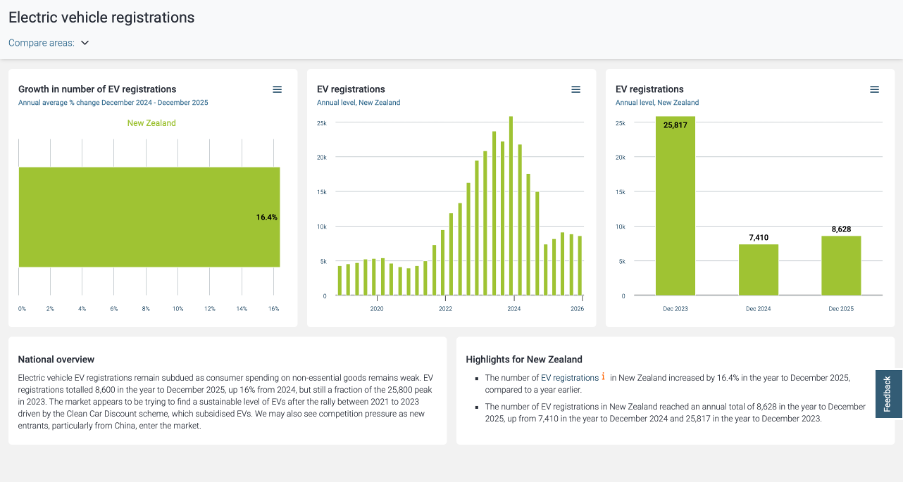
Image reproduced for purposes of education, criticism and commentary.
Not everyone wants to see sources, but some people do, and providing sources and making them easy to find adds to the credibility of your data communication. Sometimes it can be essential for viewers to really understand what they’re looking at. For instance, in this example, you may be wondering if plug-in hybrids are being counted within this dashboard or not. They were not, but the only way to know that for sure is to find and click the symbol and read that additional information about the source.
Lesson: Always show your sources, and make it easy for those who want them to find them.
Provide comparisons
While it’s clear from the last two charts that EV registrations dropped between 2023 and 2024 and from all three that EV registrations grew between 2024 and 2025, what’s not clear is how that compares to other types of vehicles. For example, during 2024 you often heard the mantra ‘survive until 2025’ reflecting the difficult economic times, so perhaps sales of all vehicles were down in 2024. Without comparative data, we can’t tell for sure.
While the second chart in the Infometrics dashboard is very helpful, the other two essentially just show the same information in different ways, and would have been usefully replaced by charts for hybrid and petrol only vehicles so we could compare and contrast registrations for each type of vehicle across time.
Lesson: A lot of data is most informative when shown in relationship to relevant comparative data.
Getting granularity right
The other thing that’s missing from the Infometrics dashboard is data for the first three months of 2026. Given the rapidly changing situation in the oil-rich Middle East, things might have changed a lot in the past few months, but we can’t tell from the Infometrics dashboard.
As I mentioned, I went to the NZTA website first because I recalled that they have their own dashboard, and that did indeed have data up through March 2026 and it did have comparative data for different types of vehicles, but it had different limitations from the Infometrics dashboard. Specifically, even after several attempts I was unable to get it to display data by month as opposed to showing it for one month or a group of months added up.
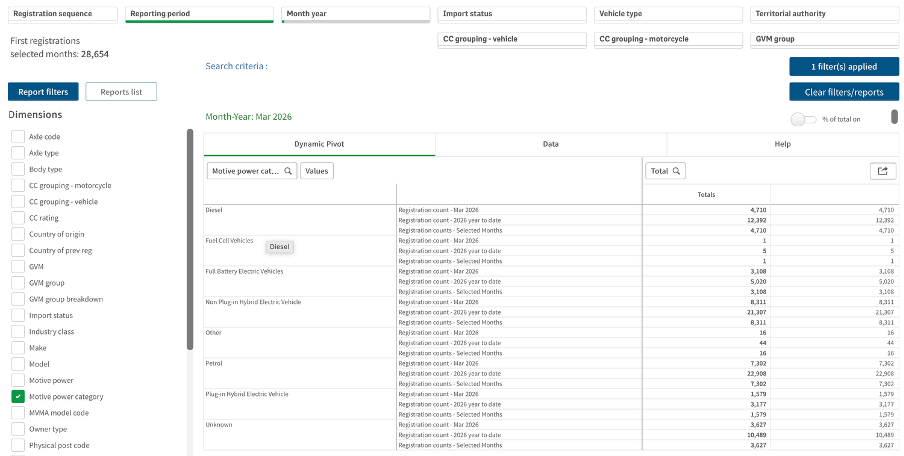
Image reproduced for purposes of education, criticism and commentary.
If I really needed to, I could have downloaded the data for January, February, and March 2026 one month at a time, but obviously that’s not the most user-friendly experience. In this situation, people making decisions about things such as whether to accelerate the roll-out of additional EV charging infrastructure probably want to know about any changes in trends sooner rather than later and therefore would have appreciated being able to access that more granular data without having to do a lot of their own manipulation of the data.
Lesson: Communicate data insights at the level of granularity that will be most useful for decision makers.
While I’m less concerned about current fuel prices and potential fuel shortages than owners of cars with combustion engines, my own EV from just a few years ago doesn’t go as far on a charge as the new ones being sold today. EV manufacturers didn’t get everything perfect on the first try. They needed to improve battery technologies and redesign car bodies to accommodate differences in things such as the weight distribution resulting from EVs having much larger batteries than internal combustion cars, but no engine.
It’s also hard to get data communication right the first time. Neither the Infometrics nor the NZTA dashboard is perfect or individually sufficient, but that same sort of patience to redesign and refine pays off in data communication, just as it has for modern EVs.