
Clearly communicating when conclusions may be complicated or contentious
Only five out of the eighty-nine countries and regions included in the World Mortality Dataset had fewer excess deaths than New Zealand over the pandemic period. That might seem unremarkable to people who lived through New Zealand’s lockdowns or to those elsewhere who read about them — except that, indexed across the full period from 2020 to 2023, New Zealand's Covid restrictions were actually less stringent than those of almost every country it is typically compared to, including Sweden, the United Kingdom, Australia, Italy, and the United States. Whether that finding surprises you or confirms what you already suspected, you don't have to take anyone's word for it. The data is right there for you to check yourself — and that is no accident.
It’s part of a recently released series of reports from the New Zealand Royal Commission examining lessons learned about the country’s experience with Covid 19. The pandemic and its aftermath are things that all adults experienced and nearly all have opinions about. It also influenced and was influenced by a complicated web of public health, economic, and legal policies and practices. In situations like this, where the data and related analysis are complex, and many people have strong opinions about, or vested interests in the conclusions, the stakes and potential for a contentious reception are high.
In communicating the results of its investigation into this period of New Zealand’s history to provide lessons to guide responses to pandemics the country may face in the future, the Royal Commission also did two things that provide important lessons for those trying to communicate data-intensive insights in the future.
Divide and conquer
Somewhat unusually, the final outputs from the Commission’s work were delivered in not one, but three reports. The main report is mainly text that systematically lays out conclusions and recommendations about different aspects of the pandemic response. Two separate reports summarise submissions made to the Commission by the public and provide a curated collection of relevant publicly available data.
The one summarising the submissions includes some photos of, and direct quotes from the people who made submissions, showing how the pandemic affected them personally. The data-oriented report includes many charts and graphs showing how New Zealand compared to other countries on a variety of measures and also tracks changes to various measures before, during, and after the pandemic.
The information in those two separate reports inform the conclusions and recommendations in the main report, but each output is hundreds of pages individually, so combining them without removing any content would have created a document of over one thousand pages. Even the most interested parties are unlikely to want to read that.
Faced with a situation like this, it helps to split things up. In some cases that might mean dividing content by topic. For example, in this case maybe separating the health response from the economic response from the legal response. Those things were all inter-twined though, so it makes sense that’s not the option that the authors chose.
Another common way of dealing with this type of problem is to make different reports for different target audiences. In this situation that might have meant one report for policy makers and another for the general public. While that’s often a good solution, the pandemic is a rare situation in that it’s one where anyone reading anything about it is likely to have some direct personal experience with it, and yet there is probably no one who is an expert in all aspects of it. Health professionals don’t understand the nuances of the economic issues that had to be addressed and vice-versa, and everyone, regardless of their professional perspective, also had personal experiences.
Splitting the content the way the Commission did made it easy for politicians and policy makers to focus on the main document to consider possible lessons for the future (and to try to attribute blame for past decisions). It also demonstrated that the Royal Commission listened to and heard the many people who made submissions to it, which is particularly important given how intense, and often sceptical, feelings around the pandemic are. Finally, it allowed people who want to dive into the detailed and comparative data to easily find that. We will look more closely at some of that data ourselves next.
Lesson: If you have a lot of data-intensive information to communicate or you are trying to communicate data-intensive information to multiple audiences with different needs, consider using multiple outputs rather than trying to create one that is intended to be everything for everyone.
Anticipate assumptions, hypotheses and objections
Focusing now on the data-oriented ‘Covid by the Numbers’ supplementary report, we can see another smart decision. That was to make it easy for people to check their own assumptions, hypotheses and objections against the actual data.
People looking at any sort of data-oriented output often have their own views about the phenomena being examined. That’s certainly true of Covid. In some cases the views may be implicit assumptions, but in others they may be explicit hypotheses about how one thing affected another. In this and other situations, we can think about our audience’s assumptions and hypotheses and anticipate objections they might have to insights being presented. I think of these as the ‘yeah, but…’ thoughts that form in people’s minds as they watch a presentation or read a report.
We can leverage our understanding of an audience’s assumptions, hypotheses and objections in constructing data-oriented outputs. The idea is that almost as soon as the ‘yeah, but…’ thought forms in the minds of the viewer or reader the next slide or the next page of the report provides the information needed to answer that question or address that concern.
In the case of Covid, a common type of ‘yeah, but…’ thought is likely to relate to other countries. For example, ‘Yeah, but Sweden didn’t have so many rules, and not that many people died there.’ Or ‘Yeah, but people in the UK were much freer to live their lives.’ The ‘Covid by the Numbers’ supplementary report addresses concerns such as those with a series of charts providing comparative data across many countries and highlighting the exact countries that are most likely to feature in ‘yeah, but…’ thoughts.
For example, Figure 23 shows excess mortality by country (going from least to most excess mortality, and also explaining what excess mortality is in a note at the bottom) and Figure 46 shows the stringency of Covid policies (going from most to least stringent, though it might have been better to always have the most desirable end of the scale at the top). Both use highlighted bars along with arrows and larger labels to make it easy to find comparator countries most likely to feature in ‘yeah, but…’ thoughts and therefore make it easy for readers to test their own assumptions, hypotheses and objections against the actual data.
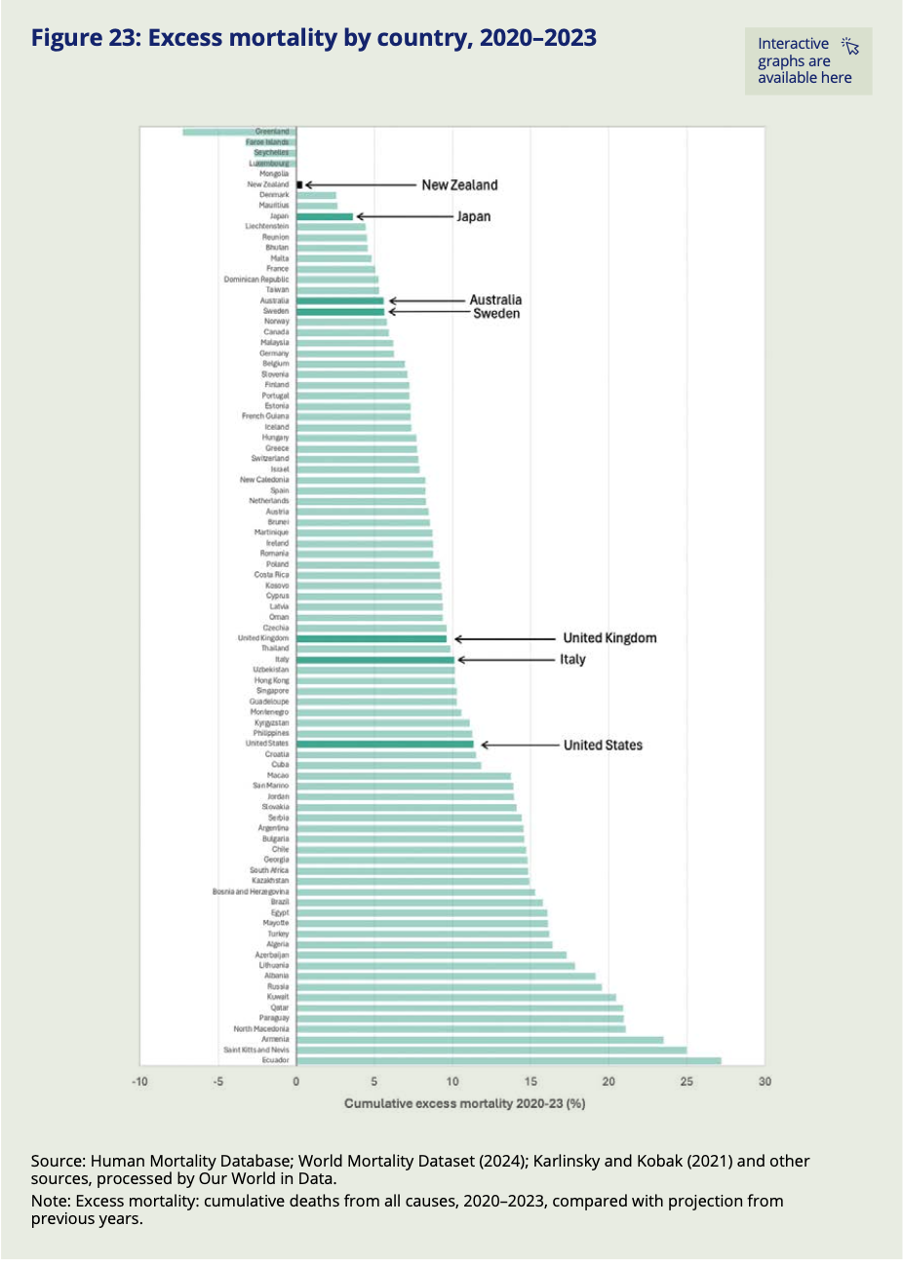
Image reproduced for purposes of education, criticism and commentary.
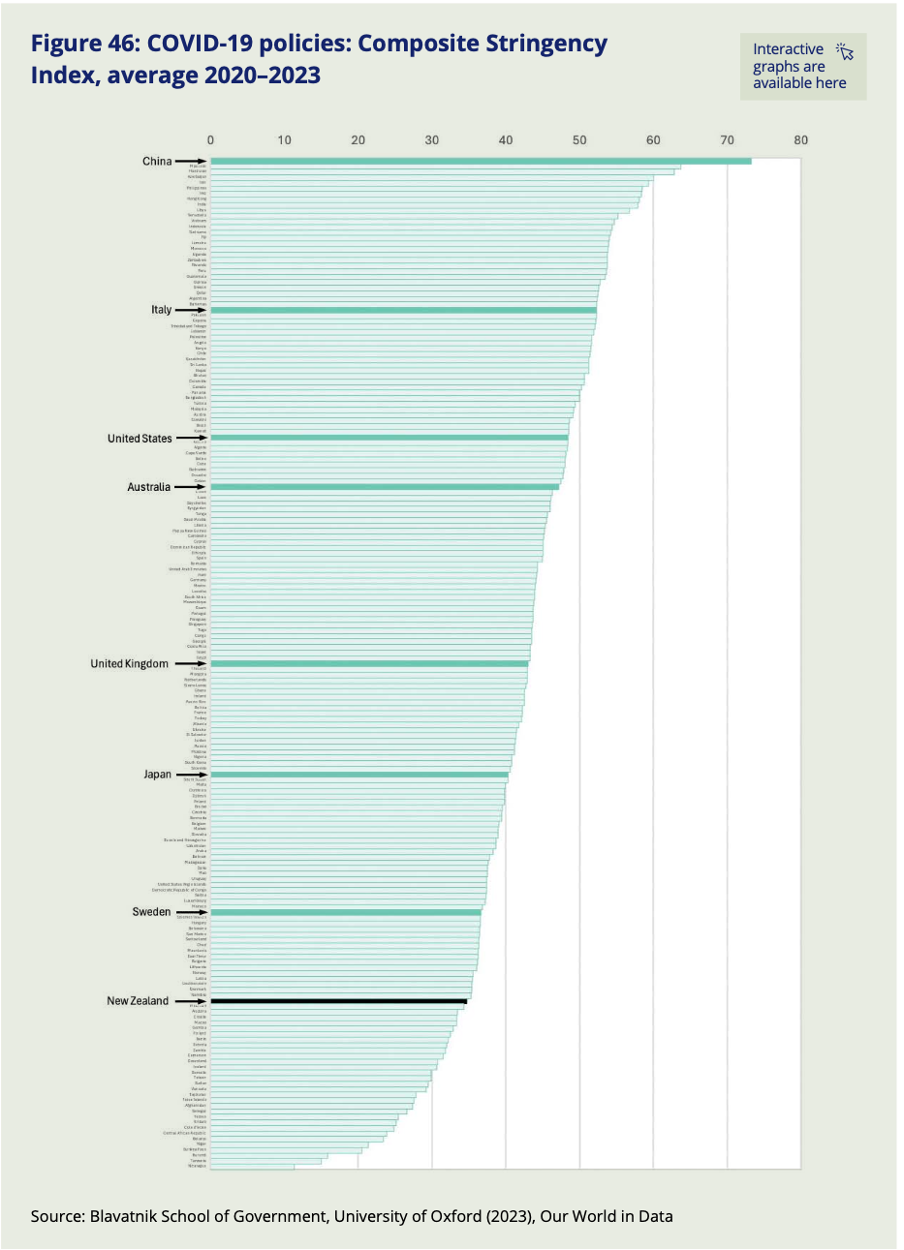
Image reproduced for purposes of education, criticism and commentary.
Lesson: Consider implicit assumptions, explicit hypotheses, or possible objections your audience is likely to have about the data you are trying to communicate and make it easy for them to test their assumptions, hypotheses and objections against the actual data.
Everyone had their own experience of the pandemic, and everyone is likely to have their own reaction to these reports — including to the findings shown in this post. Whether New Zealand's combination of near-best excess mortality and, indexed over the full pandemic period, relatively low policy stringency strikes you as expected, surprising, or still not the whole story, the Commission's choices mean that you are not left arguing from memory or anecdote. The data is there, clearly laid out, and deliberately designed to let you test your assumptions against the evidence. That is exactly what good data communication makes possible — and exactly what we can aim for when we need to communicate clearly about things that are complicated or contentious.